

Supporting net-zero construction at McDonald’s Market Drayton
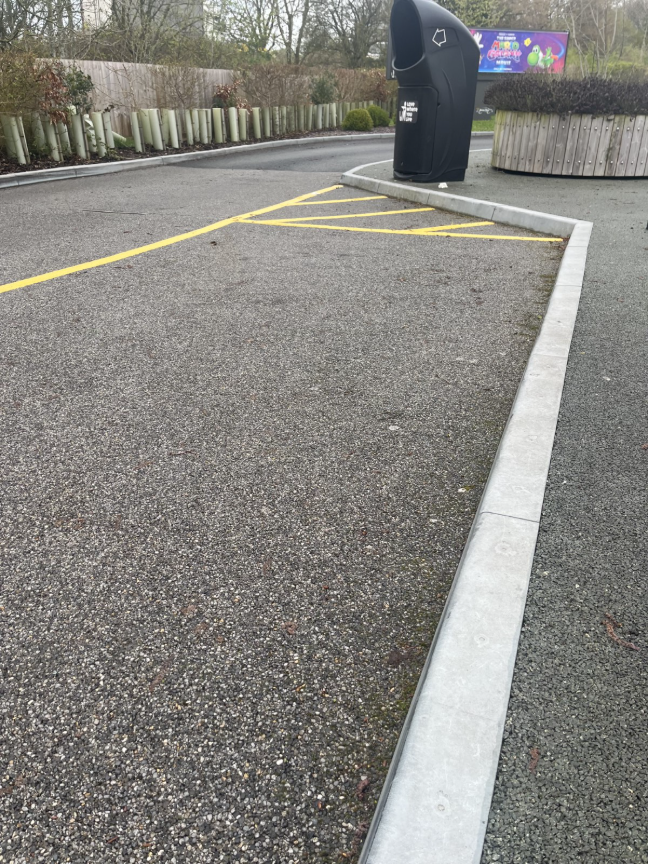
In 2021, McDonald’s set out an ambitious goal to deliver its first net-zero carbon restaurant in the UK and Ireland at its Market Drayton site.
Opened in December of that year, the site was designed to demonstrate how net-zero principles can be applied in practice. Every aspect of the build was considered through a sustainability lens, from material selection to construction methods, with a clear focus on reducing environmental impact while maintaining the performance standards expected of a high-traffic commercial environment.
Delivering performance in a net-zero context
Durakerb was selected as the kerbing solution, offering a lower-carbon alternative to traditional concrete. Manufactured using recycled materials, the system supports reduced embodied carbon and aligns closely with the project’s net-zero ambitions.
Durability was a key factor in the specification. Drive-thru lanes, parking bays and pedestrian routes place constant demands on materials. The kerbing needed to withstand repeated loading and retain its structural integrity over time. Durakerb’s proven performance in high-traffic environments made it a reliable choice.
The system’s flexibility also supported the delivery of the site’s distinctive layout. Drive-thru lanes often require curved kerbing, which can be difficult to achieve using conventional materials. Durakerb’s adaptable format allowed for a consistent, high-quality finish without adding complexity to the installation process.
In total, approximately 180–220 linear metres of kerbing were installed across the site, with the works completed over a short timeframe and seamlessly integrated into the wider civil engineering programme.
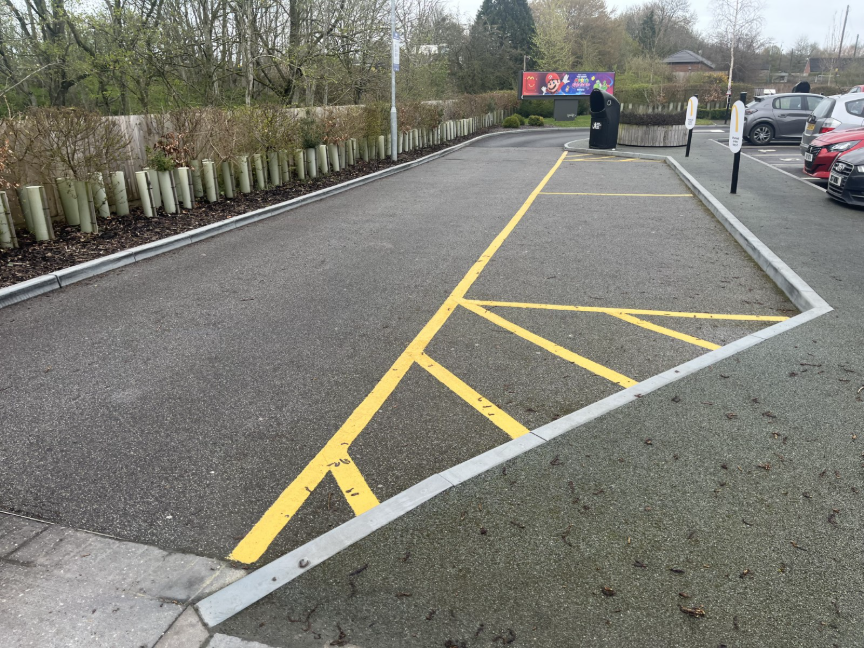
Proven performance over time
To assess long-term performance, a follow-up site visit was carried out nearly five years after installation. The findings reinforce the importance of combining sustainability with durability, particularly in high-use commercial environments where materials are subject to continuous loading over extended periods.
Despite constant vehicle movement from both light and heavy traffic, including repeated turning forces in the drive-thru areas, the kerbing continues to perform as intended. There is no visible cracking, deformation, or structural damage, and kerb alignment has remained consistent throughout the site.
Importantly, the installation has required minimal intervention since completion, with no remedial repair work required. This level of stability reduces ongoing maintenance requirements, supporting a more efficient whole-life performance profile.
The overall appearance of the site also remains strong, with the kerbing continuing to provide a clean, well-defined edge to both vehicular and pedestrian areas. This sustained performance reinforces its suitability for environments where durability, appearance, and operational efficiency all carry equal importance.
The Market Drayton restaurant demonstrates how considered material choices can contribute meaningfully to wider environmental goals, without compromising on practicality or performance.
Download PDF Version