

Durakerb helps cut carbon on M1 crossing upgrade at Bricket Wood
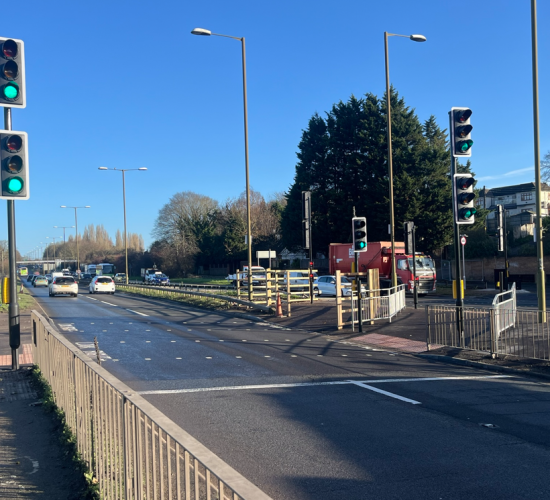
A routine technology upgrade at Junction 6 of the M1 in Bricket Wood became an opportunity to reduce carbon through careful specification and material selection.
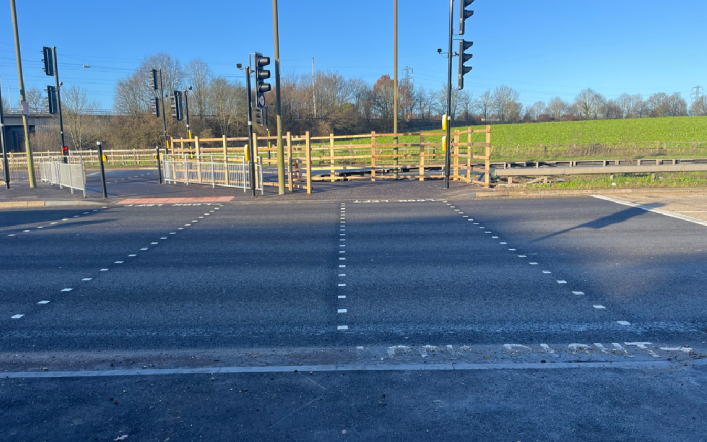
The scheme involved replacing a pedestrian and equestrian crossing over the A405 North Orbital in Watford, UK. Works included new pole retention sockets, ducting, traffic signals, poles, loops, fencing and kerb line adjustments. Delivered through a collaboration between Connect Plus, Connect Plus Services, Octavius and National Highways, the project had a fixed design and an operational highway to work around.
Download PDF Version
Finding savings within a fixed design
The team’s challenge was not to redesign the scheme, but to identify lower-carbon alternatives that could be incorporated without delaying delivery or compromising performance.
The project adopted a reduced-carbon approach aligned with PAS 2080. A carbon tracker was used to compare the likely impact of different material and fuel choices, helping the specification team focus on the elements where relatively straightforward substitutions could deliver measurable savings.
That process placed the kerb line under review alongside the other materials required for the crossing. Durakerb was selected as an alternative to traditional kerbing, providing a way to reduce embodied carbon without changing the overall layout or function of the scheme.
A lower-carbon kerb solution
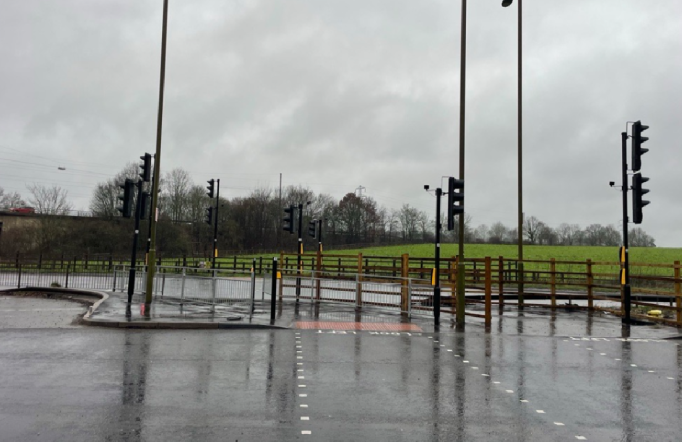
Made using 88% recycled polymer, Durakerb reduced kerb-related emissions by 49% at Bricket Wood. It allowed the team to reduce the impact of the material specification without changing the crossing layout or its performance requirements. The scheme still needed a robust and defined kerbline for a live highway environment, but traditional kerbing was not the only way to achieve that. Durakerb’s BBA HAPAS approval provided the necessary assurance for its use in the highway works.
This was particularly relevant for a live highways environment, where material choices need to balance environmental performance with durability, compliance and long-term maintenance requirements.
Part of a wider package
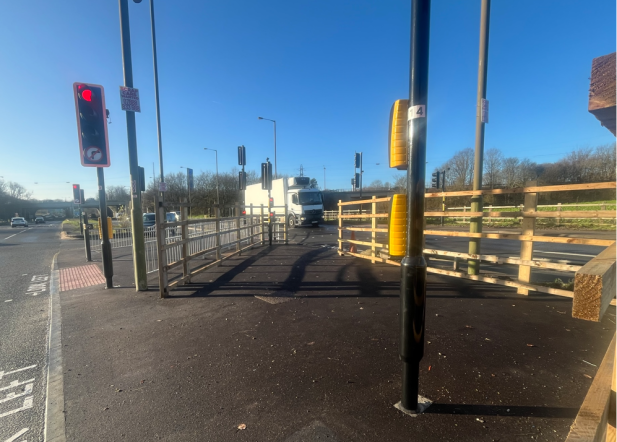
Durakerb formed one element of the project’s broader carbon reduction strategy. Other green initiatives at the site included:
- Recycled steel guardrails, which achieved a 59% reduction in carbon emissions.
- The Yunex Plus+ cabling system, which reduced embedded carbon by 57% through lower copper use and shorter cable runs.
- Warm mix asphalt, contributing a further 4% saving.
- Syntech Advanced Smart Biofuel, which reduced construction emissions by 82% compared with conventional diesel.
- Battery tower lights and hydrogen fuel cell lighting, which removed emissions from those activities entirely.
The project combined a series of practical decisions across the supply chain and construction process. This allowed the team to reduce emissions while retaining the original scope and programme.
Measured results
Together, the measures reduced the scheme’s carbon footprint by 39%, saving 11.8 tCO₂e. Durakerb’s 49% reduction in kerb-related emissions made a clear contribution to that overall result, demonstrating how the specification of relatively small, repeatable components can influence the performance of a wider highways scheme.
The Bricket Wood crossing shows that carbon reduction does not always depend on a major redesign or a new construction method. On maintenance and technology schemes, where the layout may already be established, there can still be opportunities to make a difference through the products selected, the fuels used and the way the work is planned.
For designers, contractors and asset managers, the project demonstrates in practise how assessing the carbon impact of each work package, identifying viable alternatives early and collaborating to bring those choices into the final scheme repays in environmental gain.
Durakerb is now BBA HAPAS-approved, giving projects team the assurance needed to use it within a demanding highway application without any extra specification hurdles.